

Why did Facebook remove the ‘existing customer percentage cap’ in ASC campaigns?
In an environment that challenges true incrementality more than ever, Meta continues to remove the last layers of manual control.

If you asked most media buyers whether they’d trade a kidney for better Meta support, they’d probably pause only to confirm which kidney.
From a transparency perspective, the hierarchy tends to go something like this: Amazon, Google, and then somewhere drifting through deep space, Facebook. Amazon and Google will usually assign reps early. Meta has made it clear that support, particularly fast support, is more of a performance tier benefit.
Unfortunately, that philosophy extends beyond customer service. It applies to feature rollouts too.
Meta rolls out structural changes weekly. Some accounts see them. Some don’t. Sometimes it’s a beta. Sometimes it’s a permanent shift. Occasionally, something genuinely useful appears. Other times, something quietly disappears.
The removal of the existing customer percentage cap inside Advantage+ Shopping campaigns is one of those quiet disappearances.
And it matters more than it looks.
The importance of audience segmentation
With a platform whose UI hasn’t changed too dramatically until the last year, aside from an abundance of auto-enhancement features and creative rollouts, there is one change in particular that has become a real discussion point within the team: existing customer caps.
Appropriate audience segmentation is something that still comes up in all our workshops with prospective clients, yet it should be the first thing you do as a media buyer.
For non-media buyers, audience segments are defined under advertiser settings within Ads Manager. Here you can choose how to define an existing customer and an engaged customer, your two primary segments.
Meta’s definitions are simple:
Existing customer, someone who has purchased from you in the past.
Engaged user, someone who has yet to purchase but has shown intent.
So how do we define these properly?
Normally, brands will sync a rolling 180-day Shopify or Klaviyo purchaser list to dynamically update in Facebook’s settings for existing customers. For engaged customers, we typically define this as users who have added to cart in the last 30 days, viewed the website recently, or triggered similar mid to upper funnel signals.
The benefit of defining these audiences is that in Ads Manager, under filters, you can select Audience segments and see your usual dashboard KPIs, spend, revenue, ROAS and cost per purchase, broken down into:
Existing customers
Engaged customers
And most importantly, New customers. Meta does not explicitly define this, but we assume it represents what is not attributed to the other two.
Here is what that might look like:
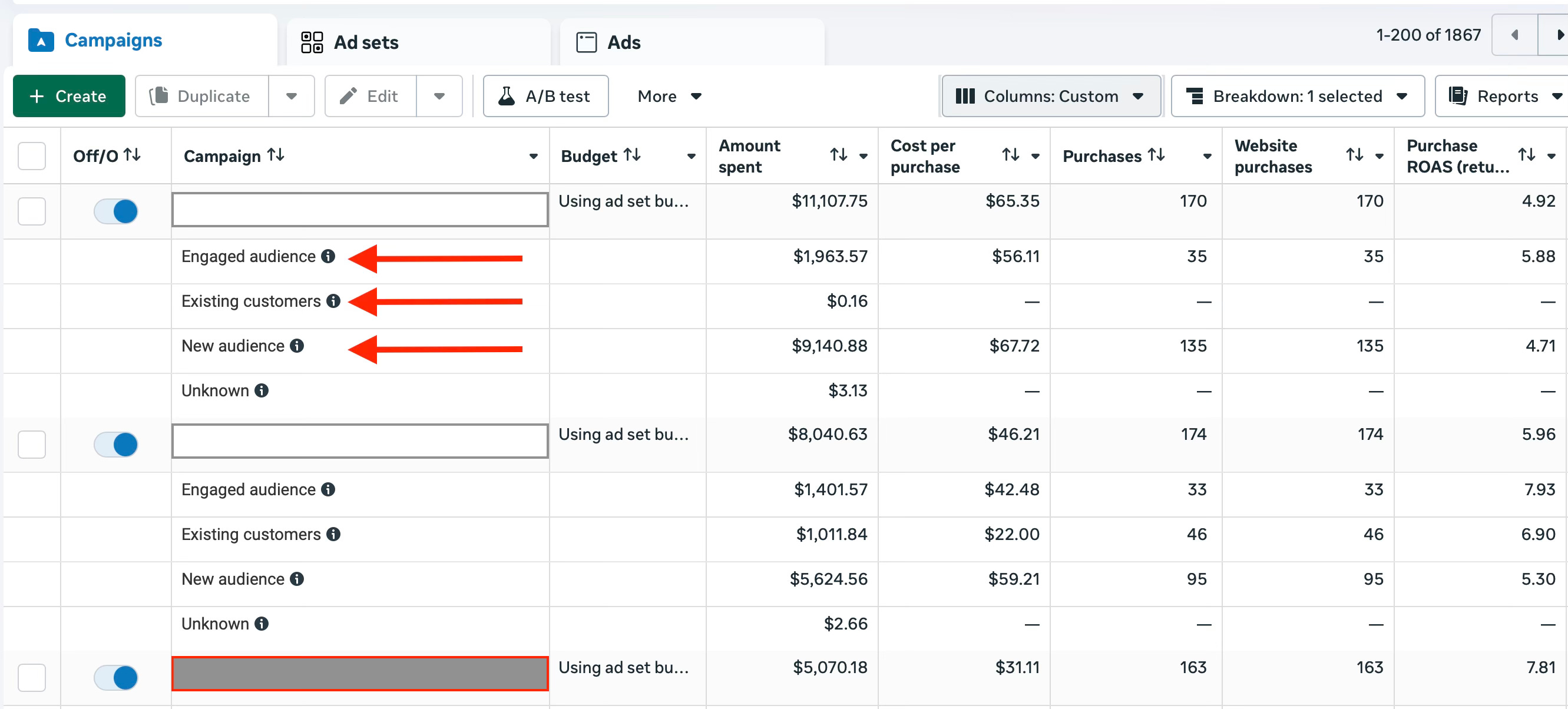
Equally important, once segments are defined, you can choose which ads to exclude existing customers from. Most brands use Facebook primarily as a prospecting engine, so allocating too much budget toward existing customers, meaning remarketing audiences, does not bring in net new growth.
So brands should be able to decide what segments they target. Right?
The feature changes with the new Advantage Plus roll-out
Here is where it gets interesting.
Previously, circa early ’25 or before, within your Advantage Plus Shopping campaign settings, you could exclude existing customers from your budget allocation by setting a percentage cap.
So, if I wanted, I could apply a 10 percent existing customer cap, or whatever percentage I chose. That would guarantee, according to Meta, that 90 percent of my spend would go to new or engaged customers, leaving only 10 percent for remarketing. I could set it to 0 percent, 50 percent, or leave it blank and let the algorithm decide where to spend my money, always risky.
However, Meta introduced a major roll-out that changed how we manage Facebook campaigns.
In summer ’25, not to sound like Bryan Adams, Meta allowed ASC campaigns to be segmented at the ad set level and budgets applied in an ABO, ad set budget optimisation, format. This partially solved a long-standing frustration: Meta skewing too much spend toward a small number of creatives within a single ad set.
With ABO available, you can isolate creative types and force budget distribution if needed. I would class this roll-out as a win, and most media buyers would probably agree.
Although, and this is the important part, while rolling this out, Meta also quietly removed the existing customer cap percentage toggle.
Instead, advertisers are now required to add exclusions at the ad set level. You select audiences defined in your settings, for example Shopify 180-day purchasers, and exclude them from targeting.
Now, if I am choosing to exclude these audiences, I would reasonably expect that 90 to 100 percent of my spend would focus on prospecting. Not 30 percent or 40 percent plus flowing back to existing customers.
So where does this leave us now?
After speaking with various agency partners and rolling out new Advantage Plus campaigns across brands in the Igloo portfolio, I can confidently say this is a meaningful step backwards in the incrementality discussion, and not one to be overlooked.
In my opinion, there are two concerning outcomes.
Exclusions do not guarantee allocation control. When exclusions are applied and prospecting campaigns still spend a significant portion of budget on existing customers, brands suddenly lose clarity over how much budget is truly going toward net new acquisition. This is happening, and it is happening quickly.
Scaling becomes harder. If I have additional budget to deploy, but I know that increasing spend results in greater remarketing leakage, I am going to hesitate. Or worse, I am going to look elsewhere, TikTok for example, for cleaner upper funnel reach.
It is difficult to see how that benefits Meta long term.
The harder part, and something I tell new founders weekly, is that Meta has made it clear through aggressive AI roll-outs and structural updates that agencies and advertisers are secondary to their revolution.
Incrementality has always been murky as brands scale into Meta’s auction, something they already struggle to control. The cloudier these roll-outs become, the more frustrated founders will grow with the tension between Meta’s drive to please shareholders and its lack of customer transparency.