

Meet Claude, my new creative strategist!
Designers are turning into prompt engineers and how Claude’s replacing the creative strategy process in media buying.

In recent months, I’ve read multiple articles from FT writers, normally among my more trusted sources, and various data junkies arguing that AI is increasing the amount we work, simple because we’re now able to generate more with less. In marketing, it’s certainly the case! More modelling, more briefs, more reports, more audits etc.
However, some large language models (LLMs) are more tailored to marketing than others, and each has its own skill set. So far we’re seeing Google’s Gemini and VEO models killing the creative game. ChatGPT has democratised mobile search. And Anthropic’s Claude is conquering code and math, all while labelling itself as a “safe” product compared to others in the market, lol.
In my opinion, and after countless subscriptions to test what works best, for our purposes as media buyers, Claude is exceptional. The more I use it, the less I use ChatGPT, whose creative output is average at best, math is poor, and data crawling is fine but not outstanding. Claude’s ability to process information, build reports, code pages and solve problems is the most impressive tool I’ve used.
In fact, it’s giving me what I imagine early Microsoft must have felt like ahead of an IPO. So the bigger question becomes: how are marketers using Claude, and why is it so helpful right now?
Claude connectors to Facebook Ads
Meta used to fall neatly into three pillars: Creative Strategy, Creative Design and Media Buying.
Pre-iOS, creative strategy was less significant because audience targeting was so reliable. As that reliability declined, the importance of strategy grew. We then saw the rise of software like Motion, Upspring and others that wrapped Ads Manager in a friendlier UI, helping strategists analyse creative performance and determine what to build next.
From there, the process became familiar. Brief development turned ideas into scripts and shot lists. Designers executed the assets. Media buyers deployed them. It was a time intensive and oftentimes tedious process.
Today, Claude has materially altered how a creative strategist operates. In fact, dare I say it, is there even a need for a strategist?
Using third-party connectors, you can now sync ad performance directly through the Meta connector within your Claude project. Claude gains access to campaign and creative performance data down to the ad level. Previously, uploading datasets, screenshots, PDFs and exported CSV reports was tedious. Now, with a simple API connector, Claude can access everything instantly.
The interesting tension here is what this means for Meta’s own optimisation engine, even though Meta’s profiting from the API pulls every time someone makes a request.
Meta’s system, whether you call it Advantage+, or whatever they have rendering in the backend, is designed to learn from creative performance inside the platform. But if brands are now analysing performance externally, synthesising insights in Claude, generating new concepts upstream and only deploying refined outputs back into Meta, the learning loop shifts. The iteration logic is no longer happening exclusively inside Ads Manager. It’s happening in a parallel AI environment.
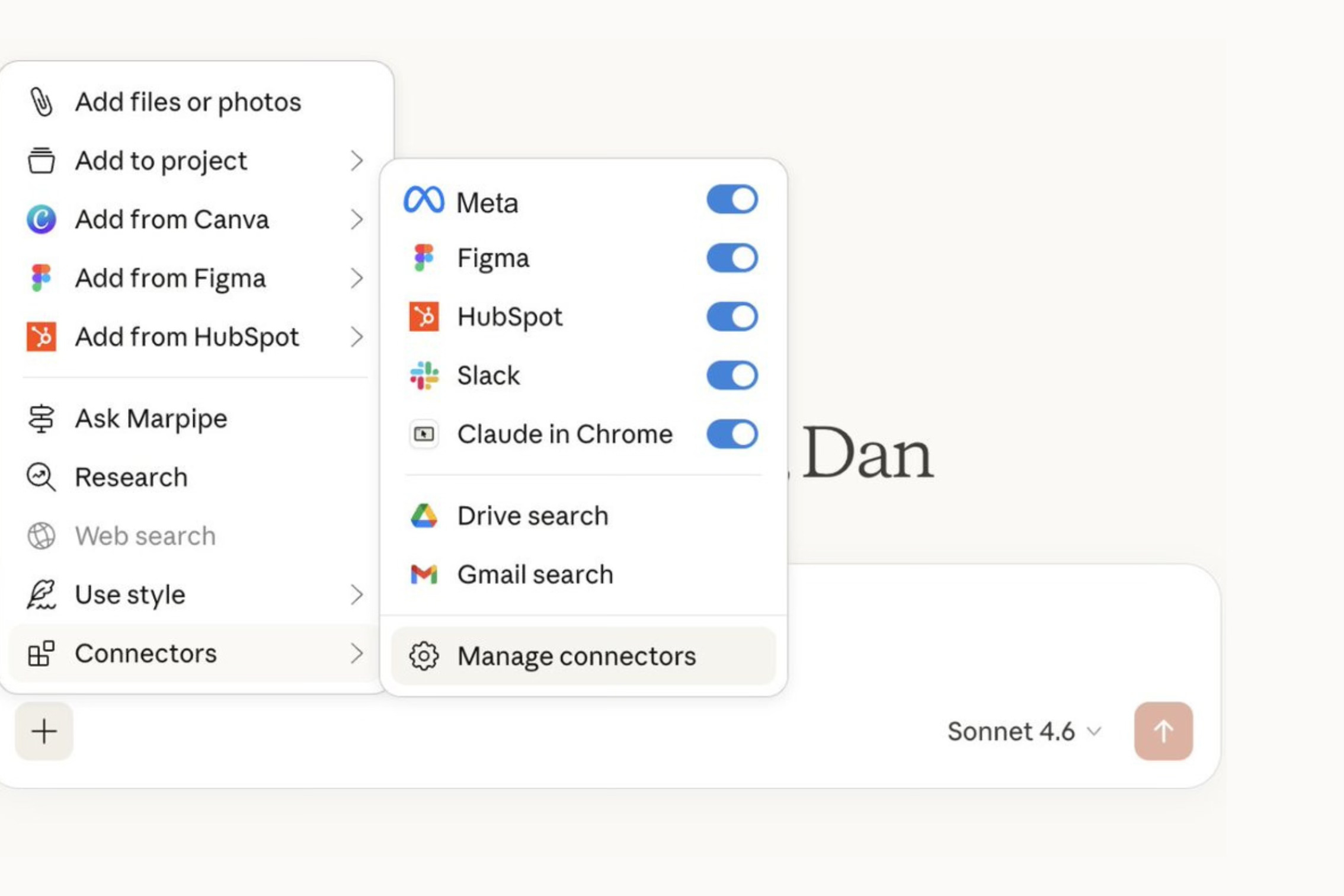
The future of asset creation for Meta through the lens of a designer
I recently spoke with Jake Winstone, founder of Green Lanes, a creative agency leveraging Weavy, acquired by Figma for $200M, to build creative assets using AI. They also use Claude to develop a closed feedback loop for every sprint across their brands.
By importing ad performance data, Motion insights, audience data, Shopify data and more, Claude can ideate new concepts directly into the design stack. This eliminates the manual process of asking, “What is it about this asset that works?”
Instead, it digests learnings from the previous sprint and uses them to improve the next. In theory, that increases creative quality over time.
Jake put it simply:
“We’re at a weird catalyst point where suddenly every brand can build almost anything using AI, video or static, depending on the designer’s skill set. But as designers, we still need to human-proof every phase of the process. One thing is clear, though - If designers want to stay competitive and justify their roles in marketing, we need to become prompt experts as well as designers. Strategists are sometimes too slow and often too expensive. If we can solve that piece of the puzzle, which we’re already doing, brands should get far more from a much faster process.”
Me: How do you value creative production if it becomes too fast?
I asked Jake this to understand where design teams sit when pricing their services.
He said, “There’s a difference between paying for Nanobanana credits and designing what looks like a nice image. Anyone can do that. But building 20 to 50 plus new concepts a month, with learning incorporated through an efficient, scalable AI system, is where the value lies. If your hit rate moves from one in four winning ads to two in four, you’re doubling effectiveness. At scale, that’s worth paying for.”
However, as we discussed it, design teams seem to be sitting in a kind of limbo when it comes to pricing, particularly on the video side.
While Claude can handle static performance analysis exceptionally well, much of the video ideation process still relies heavily on humans. AI is not quite as creatively instinctive as we are, at least not yet. As a result, even though you can now move from storyboard to final video without leaving your laptop or hiring an actor, the process remains robust and expensive. Often 3–4K for a 20–30 second commercial, because you are still paying for time.
That makes it poorly accessible to smaller brands.
As I try and imagine what the future of campaign optimization looks like, I find it very possible to see a full LLM to Ads Manager automation play, where campaigns, ad sets and ads are adjusted based on the ‘rules’ you set. Such as: ‘Turn off a creative if it has >$200 in spend and ATC <$30, unless it’s CTR is >3.4%.’ The only piece you’ll need to control is deploying creative from the design stack to the ad set, which is already possible through Canva’s Meta connector.
But in the meantime, the answer is Yes. Claude is a viable, proficient and effective creative strategist, and strategists with manual workflows are going to need to start adapting to keep up to pace.